
upload photo | donate | calendar
|
my profile |
register |
faq |
search upload photo | donate | calendar |
 10-05-2017, 10:42 AM
|
#1 |
|
User

Join Date: Jan 2017
Location: S.E. Iowa
Posts: 484
Thanks: 533
Thanked 229 Times in 125 Posts
|
 Toggle help
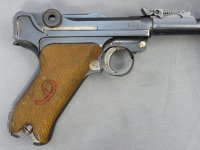
I was shooting my Mauser 42 9mm when I noticed that tiny little pin in the center toggle was coming out. It is a very loose fit, not tight at all. I need advice on how to secure that little sucker permantly. If it falls out unseen I'm sure to never find it.
Thank you, Major Tom
__________________
I Build Custom Pistol Boxes |

|

|
|
10-05-2017, 04:19 PM
|
#2 |
|
User
Join Date: Apr 2015
Location: near Charlotte NC
Posts: 4,681
Thanks: 1,443
Thanked 4,356 Times in 2,041 Posts
|
Maybe a replacement pin, undersize- you could get another from Lugerdoc.
If it is not "too" loose, a little loctite will fix it, remove it - add blue loctite replace. Don't get loctite into the "big" pin.
__________________
03man(Don Voigt); Luger student and collector. Looking for DWM side plate: 69 ; Dreyse 1907 pistol K.S. Gendarmerie |
|
|
|
|
10-05-2017, 05:13 PM
|
#3 |
|
Lifer
Lifetime Forum Patron Join Date: Jun 2002
Location: Chandler Arizona
Posts: 3,541
Thanks: 1,342
Thanked 3,743 Times in 1,020 Posts
|
middle toggle pin pin!
Hi to all, just like any other Luger part, it has to have some difficulty in either design or application, this pin is no different? I have almost always found them waaaay too tight and nearly impossible to remove, and seldom, as you have found, so loose it is literally floating in the hole...
When installing one new, I test fit, and if loose, I upset with a slight tap or two before I ever install it? Ant then, drive in from the top just like a fattened nail!  (how's that for shade tree gun smithing!) (how's that for shade tree gun smithing!) When installed, and if still yet loose, I rest the toggle top at the pin area on a brass block, and then upset the pin down from the inside area, expanding it slightly in the hole... Just need to sneak up on it with a small effort, as you can then conserve the BIG effort when you go to disassemble it the next time!  ... best to all, til...lat'r....GT ... best to all, til...lat'r....GT
|
|
|
|
| The following 3 members says Thank You to G.T. for your post: |
|
10-05-2017, 07:31 PM
|
#4 |
|
User
Join Date: Jun 2002
Posts: 339
Thanks: 81
Thanked 359 Times in 198 Posts
|
You know; adhesives have come a long way. I particularly like the Loctite(Henkel) products for specific applications. In short I have learned that color has no real implication on application and there are retainers and also thread lockers. Henkel has a nice application guide(spec sheet) with each product that tells technical specifics about the particular product, which I encourage reading thereof.
That small pin has some reputation huh?.....  Some are the berries to remove from their interference fit or years of being; I am not in direct favor of Loctite application in this senerio; jmo. You might be bumped off your gunsmith's Christmas list. Some things I can say about Loctite products, use the right one and if has to be removed most of the time is heat and duress. Never know when a Thor job might be in the future. Some are the berries to remove from their interference fit or years of being; I am not in direct favor of Loctite application in this senerio; jmo. You might be bumped off your gunsmith's Christmas list. Some things I can say about Loctite products, use the right one and if has to be removed most of the time is heat and duress. Never know when a Thor job might be in the future.The G.T. has some wisdom in his application of properly applied hammering, guess tapping with a nice flat faced hammer on a steel straight surface. There is a limit to such, and some cosmetics in a slightly flattened viewable surface sometimes. Kinda like, but different, to a hammer stroke to restore existing barrel timing or dovetail fitments. A little bashing goes a long ways. A precision fitted pin in said hole, is just that; a precision fit. If the hole is out of round for whatever reason, the replacement pin you paid big bucks for, is going to suffer the same fate. So one could ponder using a straight chucking reamer in the appropriate machine, to enlarge the hole upwards in size. Talking a small upgrade to diameter. Gage pins are relatively available in at least 0.0001" diameters, so with the Machinist Handbook on fits........yes, I read a little in that book on occasion and still not up to G.T.'s level of expertise. Someday, that pin will have to come out; it was designed that way really. Every owner eventually faces these things and to each their own. Just some pondering on how to possibles. Rick W. |
|
|
|
| The following member says Thank You to Rick W. for your post: |
|
10-05-2017, 08:48 PM
|
#5 |
|
User
Join Date: Apr 2015
Location: near Charlotte NC
Posts: 4,681
Thanks: 1,443
Thanked 4,356 Times in 2,041 Posts
|
That is a lot of words.
I recommend "blue" loctite as it is removable, and the pin will be also; way easier than many of the original pins that folks "cuss" about. No use making something easy a "production"! JMHO. If one needs to remove a loctited pin, a little heat from a hair dryer will make it even easier. As to whether it "will have to come out" in future, maybe -maybe not, but loctite will not appreciably alter the removal by a proper size punch. Like I said- BLUE, not red or green or purple- those are for other purposes. GT's method will work fine also, if the pin is relatively soft; the pin in question may be from a hardened stock- like a drill bit, they don't upset well at all. I never recommend a fix, unless I have used it successfully myself.
__________________
03man(Don Voigt); Luger student and collector. Looking for DWM side plate: 69 ; Dreyse 1907 pistol K.S. Gendarmerie |
|
|
|
|
10-05-2017, 10:25 PM
|
#6 |
|
Lifer
Lifetime Forum Patron Join Date: Jun 2002
Location: Chandler Arizona
Posts: 3,541
Thanks: 1,342
Thanked 3,743 Times in 1,020 Posts
|
better, best?
It makes me wonder, do you fellows think lok-tite better than superglue? I used tons of lok-tite when a marine mechanic, but when racing cross country snowmobiles, we drilled and safety wired EVERY thing on the chassis and suspension?... Even factory nyloc nuts couldn't be trusted.... always a better way me thinks.... My biggest problem with the adhesive route, is I can't even stand to watch paint dry! I have to mess with it until I've defeated all the good properties I was trying to impart?....
... best to all, til...lat'r....GT....
|
|
|
|
|
10-05-2017, 10:41 PM
|
#7 |
|
User
Join Date: Apr 2015
Location: near Charlotte NC
Posts: 4,681
Thanks: 1,443
Thanked 4,356 Times in 2,041 Posts
|
GT,
2 different chemicals and two different purposes. Superglue is an "adhesive", it works best with a porous surface to adhere to and is not very strong against "shearing" force- pulling yes. It may have some effect as a locking agent. Superglue is not flexible when cured. Loctite is a hardening plastic/polymer type compound , it fills spaces and turns to a solid- but does not "stick" anything together, it only works by friction from the very tight fit it causes and the nooks and crannies it fills and then solidifies into a single piece of plastic. It remains flexible, which helps with its removal. Nylon lock nuts or Nylocs are good once, if they are removed they lose tension as they have been deformed in the first installation. Safety wire is very good, but Not universally applicable, and fallible also. One might think it "best" as it is what is used on airplanes, where a "loose nut" is fatal. This is a pretty basic and over simplification of the two compounds and how they work. JMHO as an "ex" chemist and long time 'smith.
__________________
03man(Don Voigt); Luger student and collector. Looking for DWM side plate: 69 ; Dreyse 1907 pistol K.S. Gendarmerie |
|
|
|
|
10-05-2017, 10:53 PM
|
#8 |
|
Lifer
Lifetime Forum Patron Join Date: Jun 2002
Location: Chandler Arizona
Posts: 3,541
Thanks: 1,342
Thanked 3,743 Times in 1,020 Posts
|
I like the chemist part!
I got an A in College Chem? All I remember is hydrogen is light, and gold is heavy.... And when exposed to air, white phosphorous is pretty darn impressive!
..... Thanks Don, til...lat'r....GT
|
|
|
|
| The following member says Thank You to G.T. for your post: |
|
10-05-2017, 11:10 PM
|
#9 |
|
User
Join Date: Jun 2002
Posts: 339
Thanks: 81
Thanked 359 Times in 198 Posts
|
G.T.
I am under the impression that most superglues are not at their best in higher heat environments, usually around 250F or so. I am pretty limited in my superglue experience, I suspect that the TDS on some of the offerings are on the net, and could be informative as to parameters; more informative than me making conversation. Some of the blue Loctite threadlockers are rated at 650F, of course, there are lesser temperature varieties of the same blue color. So sometimes specifics are relevant. I believe that threadlockers and retainers are kinda different animals of a sort. Example of 242 or 2422 as a threadlocker and 620 as a retainer. Threadlockers for threads, retainers for cylindrical objects; of course. As you might surmise, the layman only gets certain level of materials, but I have to admit that they are pretty capable for my needs. I was informed about the 620 useage in the gun business from a friend. I did experiments, trying to gain confidence in these Loctite products, by a high temp solder and 620 on two ends of a shaft with cylinders glued on. I could not break either one, and the heat resistance with a torch was right good. The 620 proved itself to me with a NECG front banded sight. Of course, I clocked it wrong some, and my.....that took a lot of heat with a torch to get off. I have to admit, that adventure, made me improve my methods with banded sights.... Time of bond varies with some of these marvelous things, ie some are quick, some give time to fool around a little. But once they set, some are right difficult to remove nicely. I believe that context of environment is everything, everything has requirements that have to be met for a successful outing. The Loctite(Henkel) site has a lot of TDS documents if you so want to peruse for your specific needs. Rick W. |
|
|
|
|
10-06-2017, 12:21 AM
|
#10 |
|
User
Join Date: Apr 2015
Location: near Charlotte NC
Posts: 4,681
Thanks: 1,443
Thanked 4,356 Times in 2,041 Posts
|
Yes, Rick,
but this is just a "little" pin that was held in by friction when designed. There is no particular stress on the pin, and it is too light to move under its own weight if fit correctly or sealed, it does not operate in a high temperature environment. Most any blue locktite will do the job for Tom; just go to the local hardware and don't over think it. Every thing you have written is quite true, but you have made this simple fix sound like rocket science; it is not. JMHO.
__________________
03man(Don Voigt); Luger student and collector. Looking for DWM side plate: 69 ; Dreyse 1907 pistol K.S. Gendarmerie |
|
|
|
| The following member says Thank You to DonVoigt for your post: |
|
10-06-2017, 01:21 AM
|
#11 |
|
Lifer
Lifetime Forum Patron Join Date: Jun 2002
Location: Chandler Arizona
Posts: 3,541
Thanks: 1,342
Thanked 3,743 Times in 1,020 Posts
|
Rocket science!
I think we are all on the same page, and agree locktite will do nicely, but in another incident... From 1998 to 2005 I was the General manager of a Mobil gas/ service station, and one day a smartly dress fellow with a briefcase showed up looking for employment as a cashier?... Most of the time, we tried to place college students and others that seemed to be a good fit for the job.. But, this guy was definitely heads and shoulders beyond the type of job position I had to offer? I remarked that the job wasn't for Rocket Scientists, to which he replied, "I am a Rocket Scientist!"
 I would have loved to hire him, but I know as soon as a position in his field opened up, he'd be gone.. and I didn't want to invest and the waste the training? Actually probably did him a favor... ... But, it goes to show you that you never know whos going to show up when things are tough? best to all, til...lat'r....GT I would have loved to hire him, but I know as soon as a position in his field opened up, he'd be gone.. and I didn't want to invest and the waste the training? Actually probably did him a favor... ... But, it goes to show you that you never know whos going to show up when things are tough? best to all, til...lat'r....GT
|
|
|
|
|
10-06-2017, 07:38 PM
|
#12 |
|
User
Join Date: Jun 2002
Posts: 339
Thanks: 81
Thanked 359 Times in 198 Posts
|
I am not too sure about the use of “rocket scientist” here; is it a reference to a compliment or is it derogatory?.............but not going to worry a lot about it, my time is short now; does not matter right now at all. FWIW, I never made it to rocket scientist status, if that makes any difference to anyone. I just am a simple guy that likes detail.
A comment about heat in this thread was in relation to superglues as per my previous posting. Some blue loctites are ultra high heat resistant(relative term I believe); that was aimed at disassembly issues at some future point. I thought my comments were pretty low level personally, but everyone to their own on that stuff. The original poster asked for opinions about a loose retaining pin in the toggle system of the Luger. There are always alternatives to any solution, each one having their own possible side effects. The pin in the toggle may take more than one thinks, there is shock at the end of the recoil cycle, and then shocked again at the closing of the system. Lots of ways to attack the issue of a loose pin, I tried to give some insight as to only a few possible solutions. The Luger toggle has humbled me more than once with stuff flying off. Do I think that my offerings of possible solution are the best for the user?………..well, of course not. I presented some options with a bit of background references for the user to ponder, tis his decision to make; not mine. I tried to give references to allow finding out more about the Loctite products and their proper useage; at this point I am neutral on whether that was a good thing or not on this forum. I have had the privilege of working with guys that could qualify as rocket scientists, actually they were probably way above of that stuff in my own opinion. I wished often that some of that knowledge would rub off on me at the time, but ……nah, not even close. Those guys were the type of guys that if they did not know it technically in detail today………..they would be up to speed in the following morning. All in all, a hard life for me to make a living at. Oddly enough those guys had sheepskins up and down the hallways(not all but most), but never used their credentials to impress the new guy, all you had to do was to listen to them discuss. They asked difficult questions to make you think and help yourself. What a place to work in, fed me and mine for many years; but all takes its toll. I wish the guy with the Luger the best, at least he heard other opinions; the forum used to allow differing opinions, maybe that will continue in some fashion. Yeah, too wordy again........so I will give it a rest. |
|
|
|
|
10-07-2017, 08:49 AM
|
#13 |
|
User
Join Date: Jan 2017
Location: S.E. Iowa
Posts: 484
Thanks: 533
Thanked 229 Times in 125 Posts
|
Wow! Thanks for all the advice. I'm not big on using an adhesive or locktite for my issue. So, I tried GT's advice and used the hammer method. Turns out that little pin is hardened like a drill bit. I whacked it a couple times with no noticeable upset but it did put tiny little burrs on the pin. I put it back in the toggle using a plastic hammer. Not much resistence but enough I hope. This luger is a 1939 Mauser 42 that is in excellent condition. Future shooting I will put a small piece of tape over the pin if I notice it coming out. Thanks to all who responded.
__________________
I Build Custom Pistol Boxes |
|
|
|
|
10-07-2017, 10:46 AM
|
#14 | |
|
User
Join Date: Apr 2015
Location: near Charlotte NC
Posts: 4,681
Thanks: 1,443
Thanked 4,356 Times in 2,041 Posts
|
Quote:
You can also just make a new Pin- start with a 17 gage brad/nail, cut to length ++ , put it in the hole, close the toggle and upset the "new" pin with a correct size punch into the hole.
__________________
03man(Don Voigt); Luger student and collector. Looking for DWM side plate: 69 ; Dreyse 1907 pistol K.S. Gendarmerie |
|
|
|
|
| The following member says Thank You to DonVoigt for your post: |
|
10-07-2017, 02:50 PM
|
#15 |
|
User

Join Date: Apr 2016
Location: Newburgh,IN
Posts: 797
Thanks: 403
Thanked 640 Times in 339 Posts
|

Such an interesting thread with several potential fixes and informative contributions. I'd try the simplest first: loc-tite. If thst didnt hold, i then move on to some of the other approaches.
__________________
“God created war so that Americans would learn geography.” ― Mark Twain |
|
|
|
|
10-07-2017, 03:38 PM
|
#16 |
|
Lifer
Lifetime Forum Patron Join Date: Jun 2002
Location: Chandler Arizona
Posts: 3,541
Thanks: 1,342
Thanked 3,743 Times in 1,020 Posts
|
Major Tom
Hey, me thinks the pin you have is probably an old timey fix and may be exactly what you said, a modified drill bit piece? I have original replacement pins for that application, write to me at: gctomeks@msn.com and we will haggle in the manner I'm accustom to? ...
...That usually means you'll get it for free, just send me your address.... best to all, til...lat'r....GT
|
|
|
|
| The following member says Thank You to G.T. for your post: |
|
10-07-2017, 03:45 PM
|
#17 | |
|
User
Join Date: Apr 2015
Location: near Charlotte NC
Posts: 4,681
Thanks: 1,443
Thanked 4,356 Times in 2,041 Posts
|
Quote:
You will find that it does work. I have used the "trick" several times.
__________________
03man(Don Voigt); Luger student and collector. Looking for DWM side plate: 69 ; Dreyse 1907 pistol K.S. Gendarmerie |
|
|
|
|
|
10-07-2017, 04:10 PM
|
#18 | |
|
User
Join Date: Apr 2016
Location: Newburgh,IN
Posts: 797
Thanks: 403
Thanked 640 Times in 339 Posts
|
Quote:
__________________
“God created war so that Americans would learn geography.” ― Mark Twain |
|
|
|
|
|
10-12-2017, 06:51 PM
|
#19 |
|
User

Join Date: Jun 2002
Location: Rio Rancho, New Mexico
Posts: 4,583
Thanks: 958
Thanked 971 Times in 277 Posts
|
Sometime you can get the pin out if you soak the hole with penetrating oil, then put it in the freezer for a couple of days, then take out let it come back to room temps. Then put it on a lead block with a patch over the part to protect the finish. You can heat up the outside of the link with a hair dryer to expand it before the pin gets expanded much. Then an automatic center punch with the proper size end can be used to punch it loose. I have used all the tricks GT used, heck, he probably taught them to me and because I am an old fart I furget. I too did all right in College Chemistry and GTs explaination hit home again.
http://media.midwayusa.com/productim...225/225542.jpg
__________________
Thor's Luger Clinic http://members.rennlist.com/lugerman/ Ted Green (Thor Yaller Boots) 725 Western Hills Dr SE, Rio Rancho, NM 87124 915-526-8925 Email thor340@aol.com ----------------------------------- John3:3 Jesus answered and said to him, "Most assuredly, I say to you, unless one is born again, he cannot see the kingdom of God." |
|
|
|
|
10-15-2017, 10:39 AM
|
#20 |
|
User
Join Date: Jan 2017
Location: S.E. Iowa
Posts: 484
Thanks: 533
Thanked 229 Times in 125 Posts
|
Thanks to all who responded to my OP especially G.T. who supplied me with the correct pin. It was a tight fit and I'm sure it will not work itself loose again.
__________________
I Build Custom Pistol Boxes |
|
|
|
| The following member says Thank You to Major Tom for your post: |
 |
| Thread Tools | |
| Display Modes | |
|
|


 Linear Mode

