
upload photo | donate | calendar
|
my profile |
register |
faq |
search upload photo | donate | calendar |
|
|
 12-15-2008, 11:04 AM
|
#1 |
|
User
Join Date: Nov 2008
Location: Brazil
Posts: 28
Thanks: 1
Thanked 0 Times in 0 Posts
|

- Morgan Kane
You can improve your method nowadays! http://arxiv.org/pdf/physics/0601102 Thanks for the DVD! - John Sabato Thanks for the book and link!
__________________
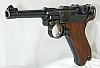
Wood grips are nicer! 
|

|

|
|
12-19-2008, 07:12 PM
|
#2 |
|
User
Join Date: Jun 2002
Location: Iowa
Posts: 769
Thanks: 0
Thanked 20 Times in 12 Posts
|
The method originally used to measure the velocity from the Luger involved the bullet severing two metal foil strips placed about 15 m or 50 ft apart. The foil carried a current. When the first strip was severed it interrupted the current to an electromagnet releasing a weight. The second strip on being severed induced a spark that marked a tape pulled by the falling weight. The method was actually quite accurate. One should bear in mind that what was actually measured was the average speed from around 5 feet to 55 feet. (The same method was used in both metric and English unit countries, 50 ft between strips in English countries pistols, 100 feet for rifles.) It's more accurate than the ballistic pendulum.
I did the ballistic pendulum thing for my project in my first college physics class. I suppose that's giving away my age. Fancy dragging a big bore revolver into the physics building these days! |
|
|
|
 |
| Thread Tools | |
| Display Modes | |
|
|


 Hybrid Mode
