
upload photo | donate | calendar
|
my profile |
register |
faq |
search upload photo | donate | calendar |
|
|
 11-11-2020, 10:42 PM |
#1 |
|
User
Join Date: Apr 2015
Location: near Charlotte NC
Posts: 4,683
Thanks: 1,444
Thanked 4,358 Times in 2,042 Posts
|

I have found that a fine wire wheel is about a close as one can get to the original, military
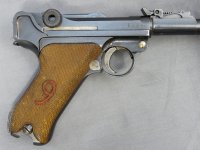
semi-matte finish. 180 grit is way too coarse, and looks just as you describe-scratchy! I would go to 320 and if you don't like that, use the wire wheel. Finish prep changed over the years also on both military and commercial lugers. If you will tell us what make and model luger you have, perhaps someone can post a picture of one in original livery.
__________________
03man(Don Voigt); Luger student and collector. Looking for DWM side plate: 69 ; Dreyse 1907 pistol K.S. Gendarmerie |

|

|
| The following 2 members says Thank You to DonVoigt for your post: |
|
11-12-2020, 10:01 AM
|
#2 |
|
User

Join Date: Feb 2009
Location: Cave Creek
Posts: 347
Thanks: 72
Thanked 276 Times in 111 Posts
|
I glass bead a LOT of parts for restoration of vintage Mercedes Gullwings and Roadsters.
Line pressure is the key (as well as grit size/material of course). It's most noticeable with aluminum castings. ~ 40 psi seems to give a nice smooth satin-like look. 120 psi gives it a shot peened appearance (not bad in some cases, but NOT for a $1M investor car). At high pressure (over 100 psi) small parts, especially sheet metal will bend, warp and twist. Also found that when polishing plastics/acrylics, a final pass with carnuba wax gives it a boost. YMMV |
|
|
|
| The following 7 members says Thank You to calibrator for your post: |
 |
| Thread Tools | |
| Display Modes | |
|
|


 Hybrid Mode

